
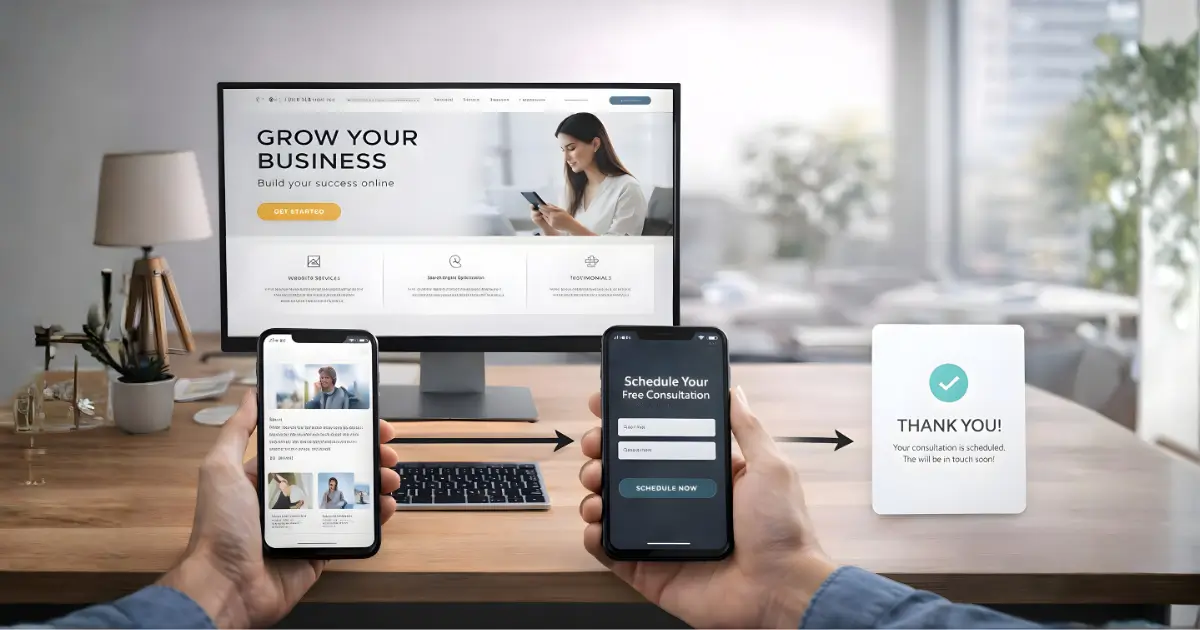
Guide website visitors to conversion by creating a structured journey that turns first clicks into confident buying decisions.
Your website should function like a trained sales professional. It should greet visitors clearly, understand their intent, build trust quickly, and lead them step-by-step toward action.
If you want to guide website visitors from the first click to conversion effectively, here’s how to structure your website with purpose.
1. Capture Attention Immediately With Clear Positioning
If you want to guide website visitors from the first click to conversion, clarity must come first.
Within seconds, users ask:
- Who are you?
- What problem do you solve?
- Why should I trust you?
If those answers are unclear, they leave.
Strategic Improvements:
A strong strategy to guide website visitors to conversion requires clarity, trust signals, and intentional user flow.
- Use a benefit-driven headline
- Add a concise supporting statement
- Include one strong primary CTA above the fold
- Remove vague messaging
Google evaluates usability and performance under Google Core Web Vitals, meaning clarity and speed both impact rankings.
First impressions determine whether a visitor continues the journey.
2. Align Messaging With Customer Outcomes
To guide website visitors from first click to conversion, shift your focus from features to outcomes.
Visitors don’t care about technical details. They care about results.
Instead of listing what you offer, communicate:
- How do you solve their problem
- What transformation can they expect
- What measurable benefits will they gain
Conversion Assets:
- Case studies
- Testimonials
- Before-and-after examples
- Clear ROI statements
Outcomes move people forward. Features simply explain how.
3. Build a Logical User Journey
A strong strategy to guide website visitors from the first click to conversion requires intentional navigation.
If users feel lost, they won’t convert.
Improve Flow By:
- Simplifying your menu structure
- Grouping related services logically
- Using consistent visual hierarchy
- Reducing unnecessary clicks
Google prioritizes mobile-first indexing, which means your mobile journey must be seamless.
Every click should feel natural and purposeful.
Businesses that invest in structured WordPress web design services often see stronger conversion performance because each page is built around user behavior, not aesthetics alone.
4. Reinforce Trust at Every Step
You cannot guide website visitors from the first click to conversion without trust.
Trust reduces hesitation.
Place credibility elements strategically across your site:
- Testimonials near service descriptions
- Certifications near pricing
- Security badges near checkout or forms
- Case studies near decision points
Trust should increase as visitors move deeper into your site.
5. Design Pages Around One Clear Goal
Every page must serve a purpose.
To guide website visitors from the first click to conversion effectively, eliminate competing CTAs.
Examples of focused page goals:
- Book a consultation
- Request a quote
- Download a guide
- Start a project
Too many options dilute action. One clear next step increases conversion probability.
6. Use Data to Refine the Journey
Guiding website visitors to conversion is not a one-time effort. It requires testing and refinement.
Use:
- Heatmaps
- Scroll tracking
- Conversion analytics
- A/B testing
Track:
- Where users drop off
- Which buttons receive clicks
- How long visitors stay
Conversion optimization is continuous improvement.
Why Guiding Website Visitors to Conversion Improves SEO
Search engines measure engagement signals such as:
- Bounce rate
- Time on page
- Interaction patterns
- Page speed
When you guide website visitors from the first click to conversion successfully, engagement improves, and improved engagement supports rankings.
Strong UX and strong SEO work together.
Conclusion: Design With Conversion as the Destination
To guide website visitors from first click to conversion, your website must combine clarity, structure, trust, and momentum.
A high-converting website:
- Communicates value instantly
- Creates a predictable journey
- Builds credibility progressively
- Ends with a clear action
Your website should not just inform. It should lead.
If your current site isn’t converting traffic into customers, the issue likely isn’t traffic volume; it’s journey design.
Guide visitors intentionally. Conversions will follow.
Ready to build a website designed to convert from first click to final action? Let’s create something strategic.
0 Comments